
How Many Rhinestones Do I Need for a Dance Costume?
Posted by Rhinestones Unlimited on Oct 20th 2026
BUYER'S GUIDE
How Many Rhinestones Do I Need for a Dance Costume?
There's no single right number, it comes down to your coverage and your stone size. Here's how to calculate yours.
Jump to
BasicsCalculateCoverageOrderingBrandsWhat Changes Your Count
Quick Answer
There's no universal number. Some dancers want a scattered accent and others want every inch covered, and both are right.
Two things drive your count:
- How much of the garment you're covering
- What stone size you're using
Measure your area, find the stones-per-square-inch number for your size below, and multiply. That's your number.
QUICK REFERENCE
| What actually determines your count | Coverage area and stone size, not garment type alone |
| Most common sizes for dance | 12ss and 16ss for detail, 20ss for coverage, 30ss for focal points |
| How to calculate | Area (sq. in) × stones per sq. in. for your size |
| Stones per gross | 144 stones |
Basics
First, the basics: how rhinestones are sized and sold
Before you can figure out how many to order, it helps to know what you're actually ordering.
What does "ss" mean?
"ss" is short for stone size. The higher the number, the bigger the stone.
12ss is small and detailed, and 30ss is large and bold. For dance costumes, 12ss, 16ss, 20ss, and 30ss are used most often. For visuals and a breakdown of ss versus mm sizing, see the Rhinestone Buying Guide: How to Choose the Right Rhinestone Size.
How are rhinestones sold?
By the gross, which is a pack of 144 stones.
If your project needs 600 stones, you're ordering enough gross to cover that number, which is about 5 gross (5 × 144 = 720). The Ordering section walks through that conversion.
Calculate
How to calculate your stone count, step by step
New to rhinestoning? Here's the whole process broken into three simple steps. No math background required.
Step 1: Figure out what kind of area you're working with
Are you filling in a shape (like a bodice panel or a whole leotard), or tracing a line (like a neckline, a seam, or the outline of a letter)? Filling and tracing use different math, so this decision comes first.
Step 2: Measure it
If you're filling a shape, measure the length and width in inches, then multiply them together. That gives you the area in square inches.
Example: a panel that's 4 inches tall and 5 inches wide is 4 × 5 = 20 square inches.
If you're tracing a line, just measure the length of that line in inches. That's it, no multiplying needed.
Step 3: Multiply by the number for your stone size
Every stone size has two numbers: how many stones fill one square inch, and how many line up across one inch.
Find your size in the chart below, then multiply your measurement from Step 2 by that number. The result is how many stones you need.
| Stone Size | If Filling: Stones per Sq. Inch | If Tracing: Stones per Inch | Best For |
| 10ss / 12ss | 68 | 8 | Detail, outlines, facework |
| 16ss | 43 | 7 | All-over coverage |
| 20ss | 30 | 5 | All-over coverage, primary size |
| 30ss | 16 | 4 | Bold focal points, back-row visibility |
| 34ss | 13 | 3 | Statement pieces, maximum drama |
Source: Rhinestones Unlimited Stone Sizing Tool & Estimating Guide. (34ss stones-per-inch is an estimate; all other figures are from the guide.)
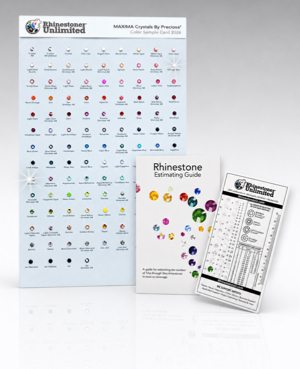
Want these numbers in your hands while you work? The Stone Sizing Tool & Rhinestone Estimating Guide pairs a sizing card with spacing layouts and formulas for calculating quantities. Looking for color charts too? Find them in our Reference section.
Worked Example
Let's fill a bodice panel that's 4 inches tall and 5 inches wide, using 20ss stones.
Step 2: 4 × 5 = 20 square inches.
Step 3: 20ss fills at 30 stones per square inch, so 20 × 30 = 600 stones for that panel.
In gross: 600 ÷ 144 = 4.17, so you'd round up to 5 gross to have enough.
Coverage
How do I decide how much coverage I want?
Two dancers can rhinestone the exact same leotard and land on completely different totals, and both would be right. Coverage is a design choice, not a fixed rule. Here's the general spectrum:
| Coverage Style | Roughly How Much of the Area |
| Scattered accent | 10–25% of the area |
| Moderate / pattern coverage | 40–60% of the area |
| Full, edge-to-edge coverage | 90–100% of the area |
Worked example: Say your bodice panel measures 100 square inches, and you're using 20ss at 30 stones per square inch.
| Coverage | Stones | Gross |
| Full coverage | About 3,000 | About 21 |
| Moderate pattern (50%) | About 1,500 | About 11 |
| Scattered accent (15%) | About 450 | About 4 |
Same panel, same stone size, three very different counts, because coverage is your call, not ours.
Trim and neckline outlines are calculated separately by linear inch, use the chart in the Calculate section for those.
Ordering
How do I turn a stone count into an order?
Rhinestones are sold by the gross. Once you have your total stone count, convert it using the chart below and round up, curve fill-ins and adjustments always eat into your buffer.
| Package | Stone Count |
| ¼ gross | 36 stones |
| ½ gross | 72 stones |
| 1 gross | 144 stones |
| 2 gross | 288 stones |
| 10 gross | 1,440 stones |
Package sizes vary by stone size and brand. For a larger project, you'll typically combine multiple packages to reach your total.
Outfitting a full team? Buy your rhinestones in full packages, then add our Custom Small Packaging Service to split that package evenly into as many smaller packs as your group needs, instead of counting out each dancer's share yourself.
Brands
Which crystal brand should I order for a dance costume?
Quantity and budget go hand in hand, here's what each crystal brand actually offers so you can match it to your project.
| Crystal Line | Tier | What It Offers |
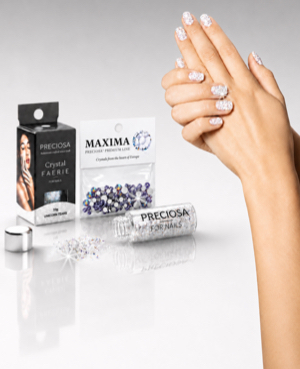
| MAXIMA Crystals by Preciosa® | Premium | Up to 15 facets (18 in larger sizes), reflecting up to 264 rays of light for maximum brilliance |
| Swarovski® | Premium | The original Austrian crystal, available by special order in limited quantities |
| Preciosa VIVA12® | Mid-tier | A 12-facet European cut with consistent sparkle at an accessible price point |
| LUX European Crystal® | Mid-tier | Bright European sparkle with reliable consistency, priced between value and premium |
| Starcut Crystal™ | Value | A cut engineered as a dependable alternative to the discontinued Swarovski 2088 |
| PriceLess Crystal™ | Budget | AAA grade genuine crystal, the most cost-effective option we carry |
See the full brand comparison, including faceting sketches for each brand, in our Brand Comparison guide.
What Changes Your Count
What else changes my final count?
- Pattern style. A honeycomb or edge-to-edge pattern uses the full stones-per-square-inch number above. A scattered or sparse pattern can use half that or less.
- Mixed sizing. Most costumes blend a primary size (often 20ss) with a smaller detail size (12ss or 16ss) for curves and gaps, and sometimes a larger size (30ss) for focal points. Budget for all three separately. The Rhinestone Buying Guide: How to Choose the Right Rhinestone Size shows how each size looks.
- Trim and outlines. Necklines, seams, and hems are calculated by linear inch, not square inch, see the chart in the Calculate section.
- Your buffer. Always round up. A few extra stones cost far less than stopping mid-project to reorder.
FREQUENTLY ASKED QUESTIONS
How many rhinestones do I need for a leotard?
It depends on your coverage. Measure the area, then use the chart in the Calculate section: at 20ss, full coverage runs about 30 stones per square inch, a moderate pattern around half that, and a scattered accent well under that. Same leotard, different totals, depending on the look you want.
What stone size should I use for a dance costume?
20ss is the most common choice for all-over coverage. Use 12ss or 16ss for fine detail and curves, and 30ss for bold focal points that need to read from the back of the theater. See the Rhinestone Buying Guide: How to Choose the Right Rhinestone Size for visuals of each size.
How many gross of rhinestones should I order?
Once you've calculated your stone count using the Basics and Calculate sections, divide by 144 to get your gross. Round up rather than down, extra stones cost far less than stopping mid-project to reorder.
Should I order extra rhinestones?
Yes. Curves, multi-color designs, and full-coverage patterns all eat into your buffer faster than expected. Most rhinestoners round up rather than risk running short and reordering mid-project.
Can I split a bulk order into smaller packs for a team, without counting each one myself?
Yes. Order your rhinestones in a full package, then add our Custom Small Packaging Service to have that package split evenly into smaller, equal packs, for example, a 10-gross order divided into ten 1-gross packs.
SHOP THIS POST
→ Shop Rhinestones for Dance Costumes
→ Stone Sizing Tool & Rhinestone Estimating Guide
→ Rhinestone Buying Guide: How to Choose the Right Rhinestone Size
→ Rhinestone Color Charts (Reference)
→ Custom Small Packaging Service
→ How to Rhinestone a Dance Costume
→ How Many Rhinestones? (General Project Guide)