
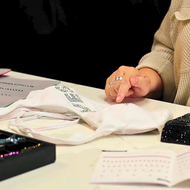
How Many Rhinestones | Calculate Your Crystal Needs
Posted by Rhinestones Unlimited on Jan 4th 2026
For today’s Rhinestones 101 lesson, we’re answering the question that stops SO many projects right at the starting line:
✨ How Many Rhinestones Do I Need?
You’ve picked your design, your crystal line, your attachment method… and then you hit the part that involves math. (Deep sigh.) Don’t worry—this post is designed to make estimating feel simple and doable, even if you’re more of a “visual learner” than a “calculator person.”
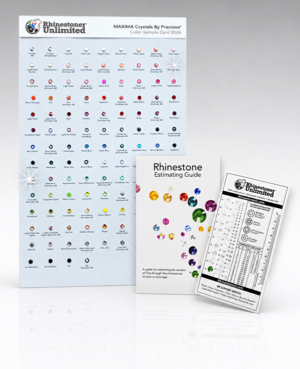
Want a head start? Use our Rhinestone Estimating & Size Guide to calculate coverage, linear measurements, and stone counts for your project — all in one place.
✨ Download the Free Rhinestone Estimating Guide
We made this to save you time (and sanity). Our Estimating Guide includes pre-calculated linear distances and coverage charts for common stone sizes so you can plan faster.
Printing reminder: set your printer to 100% scale so the measurements stay accurate.
✨ Watch: How to Estimate Rhinestones for Any Project
If you’re a visual learner, this video walks through the estimating process with real project examples before we jump into the numbers.
✨ Step 1: Define Your Project (Outline vs. Fill)
Before you measure anything, decide what kind of rhinestoning you’re doing. This makes estimating about 10x easier.Are you outlining?
Outlining means you’re tracing seams, edges, shapes, letters, or borders. You’ll estimate using linear inches (stones per inch).
Are you filling?
Filling means you’re covering an area—like a bodice panel, phone case, tumbler, or a full shoe. You’ll estimate using square inches (stones per square inch).
Quick tip: Most projects use both. Example: 20ss for coverage + 12ss for curves and tiny gaps.
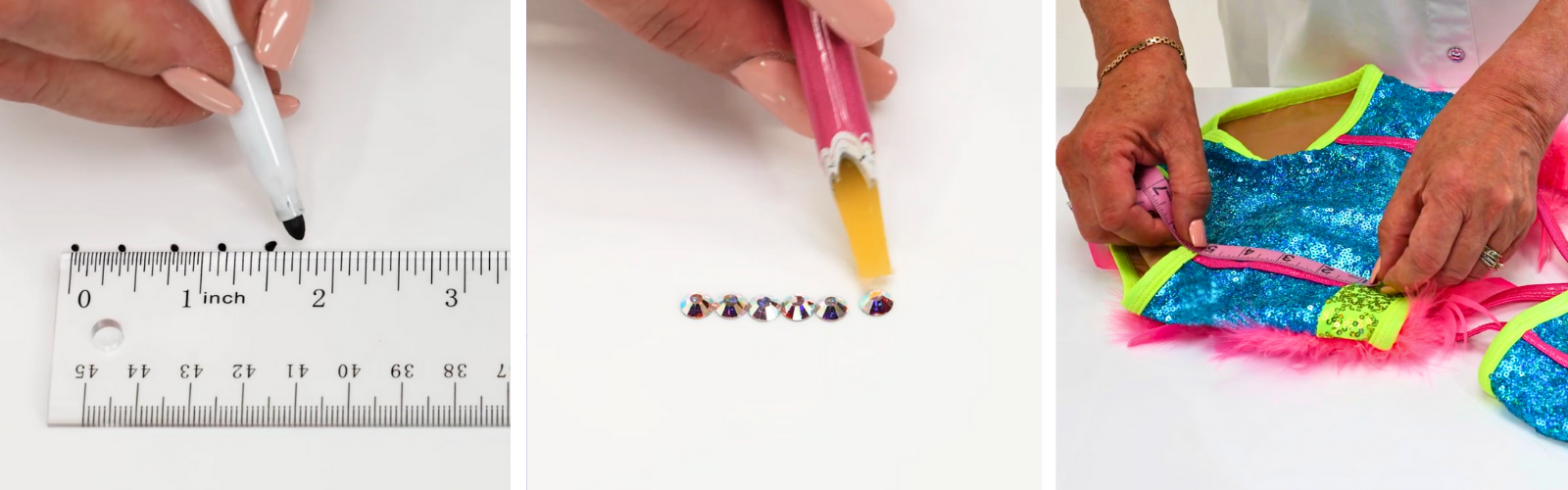
✨ Step 2: Measure the Space (Be Your Own Measuring Tool)
Here’s the secret: you don’t need a fancy setup to measure curved or tricky areas. You can use your body as a quick estimating tool—especially for sleeves, bodices, circle skirts, and other non-linear spaces.
- One yard: hold a yardstick or fabric in your hand and extend your arm—note where it lands on your chest.
- One foot: elbow to wrist is a surprisingly accurate “craft foot.”
- Hand span: thumb to pinkie helps estimate widths fast.
- Palm area: many people’s palm is close to ~10 square inches (great for scatter estimates).
- Pointer finger length: often around ~3 inches (handy for quick checks).
Once you have a rough measurement, you’re ready to estimate using the calculators below (or the guide you downloaded).
✨ Step 3: Use the Quick Calculators
Want quick math without overthinking? Use these estimates as a fast reference. (And yes—bookmark this page.)
Rhinestones Per Linear Inch (Outlining)
- 5ss: 14
- 7ss: 12
- 9ss: 10
- 12ss: 8
- 16ss: 7
- 20ss: 5
- 30ss: 4
Rhinestones Per Square Inch (Filling)
- 5ss: 196
- 7ss: 144
- 9ss: 100
- 12ss: 64
- 16ss: 49
- 20ss: 30
- 30ss: 16
Math reminder: 2" wide × 5" long = 10 square inches.
✨ Step 4: Convert Your Estimate to Packages (Gross)
Once you’ve estimated your stone count, you’ll want to translate that into how many packages to order.
How many rhinestones are in a gross?
- 1 gross (12×12) = 144 rhinestones
- ½ gross (6×12) = 72 rhinestones
- 5 gross = 720 rhinestones
- 10 gross = 1,440 rhinestones
Pro tip: If you’re between quantities, round up. Curve fill-ins, design tweaks, and “oops” moments happen—and extra stones save projects.
Some specialty shapes may come in different quantities, but in general, full manufacturer packages offer the best value per stone.
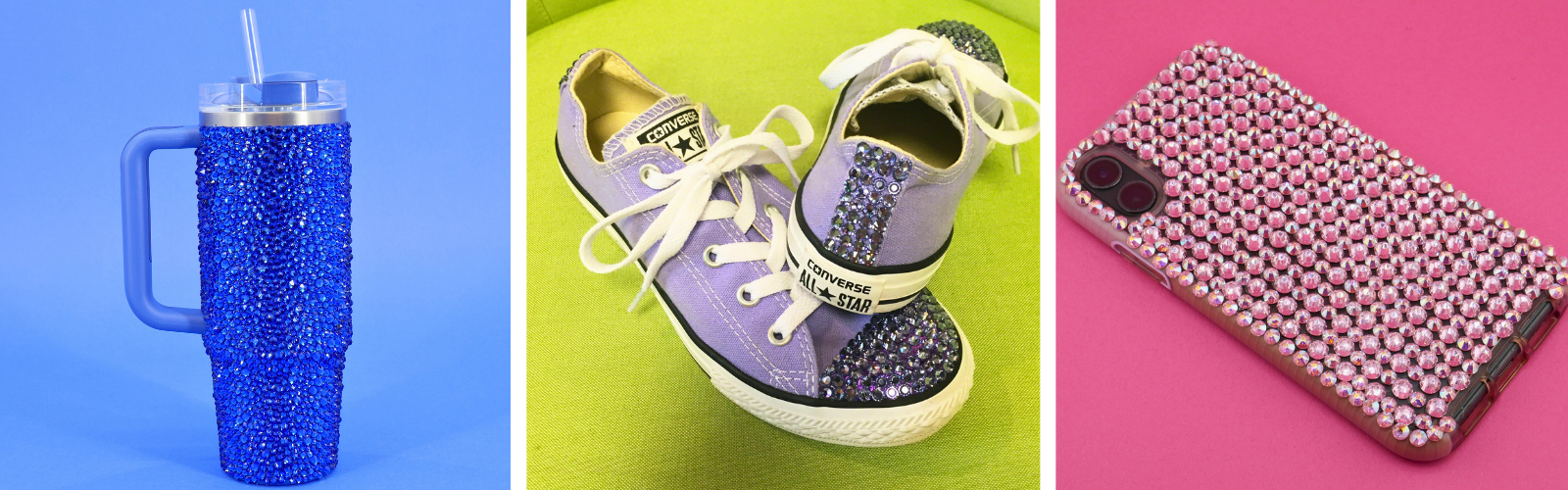
✨ Real Project Examples
How Many Rhinestones Do I Need to Cover a Tumbler?
For an average-sized tumbler with a simple honeycomb pattern, we estimate 2,500–3,000 stones of 20ss.
If you’re adding a name, curves, or detailed shapes, grab some smaller stones, such as 12s, to fill gaps cleanly.
How Many Rhinestones Do I Need to Cover Converse?
We love Converse covered in crystals. For an average woman’s size 7 with full coverage in a honeycomb pattern, we estimate:
- 15 gross of 20ss (main coverage)
- 5 gross of 12ss (curves and edges)
Adjust based on your colors, pattern, and how much of the shoe you’re covering.
Quick Planning Tips for Other Projects
- Phone cases: measure the back surface area and use stones per square inch for full coverage.
- Caps/hats: outline the brim using stones per inch; fill front panels using stones per square inch.
- Costume bodices: estimate one panel or one cup, then multiply—front and back add up fast.
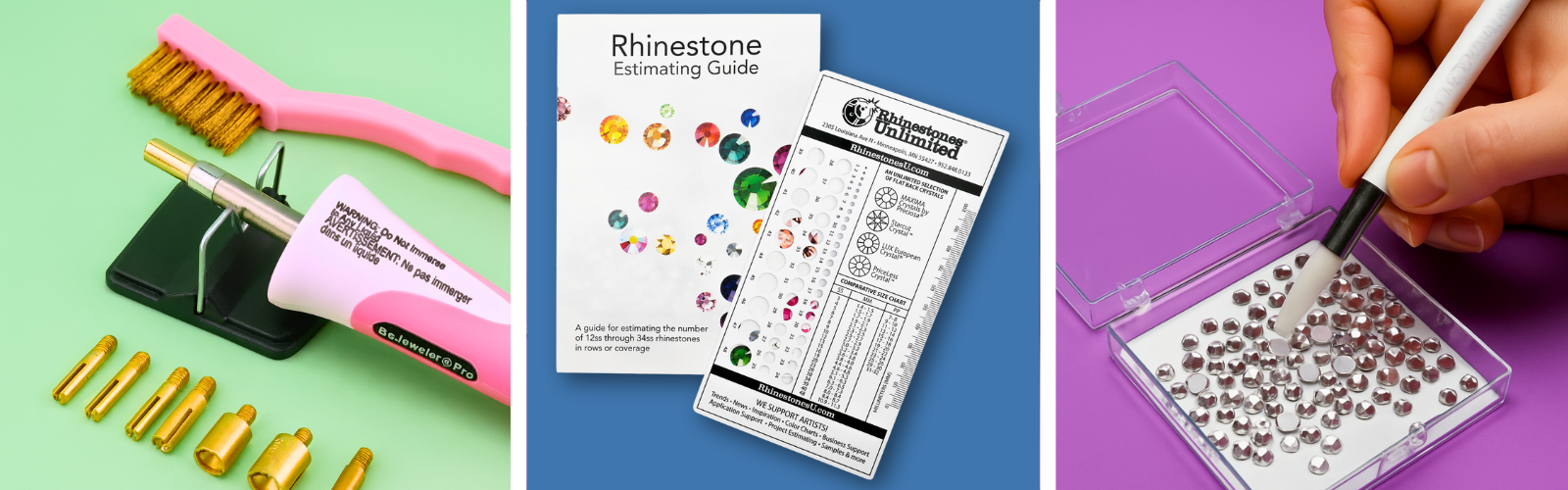
✨Tools & Supplies That Make This Easier
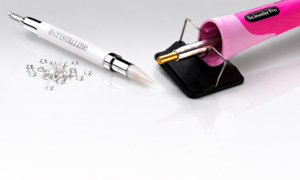
Estimating is step one—application is step two. These tools help your rhinestoning go faster and cleaner:
✨ FAQs
Should I order extra rhinestones?
Yes. If you’re working with curves, multi-color designs, or full coverage patterns, ordering extra is smart. Most rhinestoners round up to avoid running short mid-project.
Do I need smaller stones for curves?
Usually, yes. Many makers use a main size (like 20ss) for coverage and keep a smaller size (like 12ss) on hand for tight spaces and curve fill-ins.
What’s the easiest way to estimate a repeating pattern?
Estimate one repeat (like one flower), count how many repeats fit in a measured section (like a 6" square), then multiply by how many sections fit on your surface.
✨ Final Thoughts (and a Reminder to Have Fun)
Designing with rhinestones is part planning, part experimentation, and part creative instinct. Some layouts sparkle differently than you expected. Some colors surprise you. And sometimes your “final plan” changes halfway through—and that’s normal.
Think of rhinestones as a Choose Your Own Adventure story. No need to fret—no matter which path you choose, they all bring you to a gorgeous end product.
Share your sparkle with us: @rhinestonesunlimited
✨ Continue the Rhinestones 101 Series
If you’re planning a project from start to finish, these guides pair perfectly with this one:
Grab the Free Estimating Guide (print at 100% scale)